Concern · Redness & visible vessels
Why does my skin stay red, or show visible vessels?
What you may be noticing
A flush that doesn't fully settle. Redness across the cheeks or center of the face that seems to have no single trigger. Small visible vessels, often around the nose or cheeks, that don't fade the way a passing flush would. These can occur separately or together — and they aren't necessarily the same finding.
One concern, more than one kind of red
Diffuse redness and discrete vessels are not the same target.
Facial redness can be transient or persistent, and it may have vascular, inflammatory or environmental contributors. A general flush across the skin and an individual visible vessel are different findings, and they are not necessarily addressed with the same treatment.
What Dr. Lancho assesses
- Pattern and persistence
- Triggers
- Visible vessel characteristics
- Background inflammation
- Skin sensitivity
- Pigment/vascular overlap
- Previous treatment response
Clinical reasoning
Three patterns, assessed separately.
Diffuse redness
A general flush or background redness across the skin, without a single vessel you could point to. Often has an inflammatory, sensitivity-related or environmental component.
Discrete vessels
Individual visible vessels, distinct from background redness. Their size, depth and location change which vascular-targeted approach is appropriate.
Overlap with pigment
Redness and pigment can sit in the same area at the same time. Treating one without recognizing the other can leave the visible finding only partly addressed.
Treatment approaches
The goal isn't to "remove red" — it's to treat what's creating it.
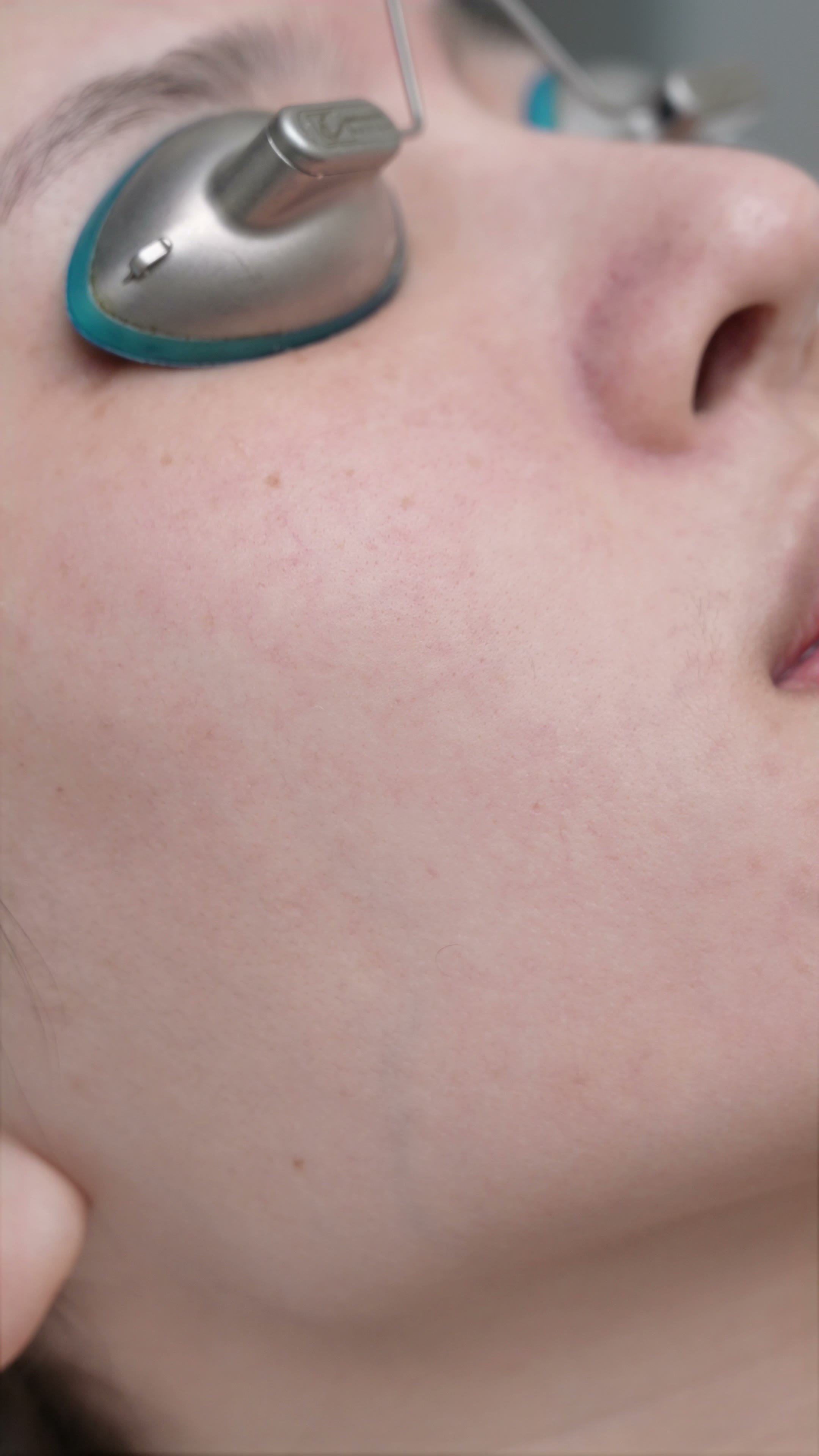
Depending on which pattern the assessment finds, an approach may draw on vascular-targeted pulsed-dye laser treatment, or a broader light-based platform capable of addressing redness alongside pigment or textural components in the same session.
When combination treatment makes sense
Diffuse redness, discrete vessels and pigment overlap can all be present in the same patient, at the same time. Where more than one genuinely contributes, Dr. Lancho may consider a staged approach where each component is given its own defined role, rather than treating the whole area as a single uniform target.
What treatment can — and cannot — change
Results depend on the underlying pattern, the treatment selected and individual biology. Redness with a strong trigger or sensitivity component can recur if the trigger itself isn't addressed — treatment changes what's visible in the skin, not necessarily the tendency that produces it.
Related treatments
Vascular-targeted pulsed-dye laser treatment — Selected for discrete vessels and vascular redness once the pattern has been assessed.
Vbeam
Multi-application light & fractional platform — Useful when redness coexists with pigment or textural change — one component of the platform, or a sequence, depending on what's actually present.
Nordlys
Depending on additional components identified during assessment, a dual-wavelength laser platform or RF microneedling may also be considered.
Before your consultation
Bring the pattern, not the label.
"Redness" describes what you're seeing, not what's causing it. The consultation is where diffuse and discrete components are separated, so treatment addresses what's actually there.